
2026 Midyear Investment Outlook
Play Short, Think Long
With the 2026 World Cup on the horizon, Allspring’s investment experts highlight tactical opportunities to “play short” in the market and provide longer-term strategic portfolio themes to consider.
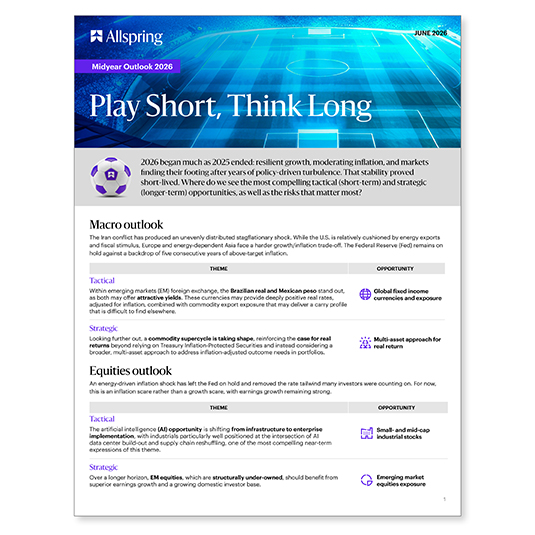
Midyear Outlook summary
Play Short, Think Long
Read the quick summary of Allspring’s 2026 midyear investment outlook, highlighting the key portfolio themes experts identified, along with the opportunities to capitalize on them.
Allspring PMs: World markets video
World markets: From group stage to knockout
Every year, markets start with a crowded field of competing themes. Back in January, many looked like contenders, but now that we’re halfway through 2026, which ones have advanced to the next round? Find out in our world market Midyear Outlook.
Transcript
Nick Venditti: Welcome to the World Cup edition of our midyear outlook here at Allspring. Entering into the year in the group stage, we had two big themes. Number one was the prospect of lower interest rates, and number two was the potential outperformance of munis. Here we are, six months in, and the prospects of lower interest rates have already been knocked out of the match with no sign of recovery before the end of the year. But the good news is the underdog muni returns have advanced and look poised to continue that advancement given geopolitical uncertainty. If I've said it once, I've said it 100 times—the water and sewer system here in Milwaukee, Wisconsin, is not impacted at all by the situation in Iran. A small school district in Southern California has nothing to do with the turmoil in the Middle East. If you are worried about geopolitical volatility—and in this world, it's hard not to be—I believe muni assets are a great place to consider investing.
John Campbell: Wow, that was quite a start to 2026. We came out of the gates with small caps, value stocks, and international stocks all roaring higher. However, once the conflict with Iran started, we saw a sharp reversal and a pretty good sell-off in the market. Surprisingly, despite no real resolution to the conflict, we've had a V-shaped recovery that's brought the markets back to all-time highs. One of the things that fueled that recovery has been very strong earnings. When looking at the S&P’s first quarter earnings, consensus expectations were for about 15% growth, and we almost doubled that at 28% earnings growth. This also drove more crowding into the AI (artificial intelligence) theme, and the momentum factor has really been on a tear. As we go into the second half, there are quite a few things that we need to be on guard for and maybe sources of volatility. First, it's the Fed (Federal Reserve). We've got a brand-new Fed chair, and markets have an uncanny way of testing new Fed chairs. The Fed is going to have to deal with an elevated level of inflation that's partially fueled by higher oil prices. And so, if those remain high for longer, then we could even see the Fed having to raise rates instead of cut rates. Second, the concentration issue is really going to hinge on the course of AI spending over the remainder of the year and the next year. As it stands now, 2026 spending is probably going to continue to be pretty strong as all of those orders are already booked and on the way. However, as we approach the end of the year, investors are going to turn their focus to the future in 2027, and there will probably be a whole new set of fears around potential bottlenecks in the supply chain. So, we think it would be prudent to perhaps diversify a little bit away from this momentum and crowded part of the market and look to add some value and some quality into your portfolio.
Noah Wise: It's 2026. That means we are getting close to the start of the World Cup group stage. We were expecting the year to be a little bit slower, more controlled. Investors really focused on income doing the work. But that’s not what we got. Instead, what we got and what got knocked out in the first half of the year was low volatility. Instead of a quiet start to the year, fixed income markets really came out pressing early. So, who advanced here so far in 2026? Who's advanced is income and credit. Yield-focused buyers are still very much in the game, and credit has been surprisingly resilient despite all of this volatility. So, where are we as we approach halftime? And what’s the score? We still think it's tied with spreads remaining tight and yields still being very, very attractive. So, despite all of the frenetic activity, this match is still very much undecided. Really, so far in the first half, the game changer has been inflation, given all of the events in the Middle East and the war in Iran. But we think the underdog to watch out for in the second half of the year is disinflation. That means we think investors should be looking at these higher yields as an opportunity, and investors should be looking at this as an ability to lock in yields and take a longer-duration posture in their portfolios as well. So, as we close out and we do move into the half-time part of the year, we really think investors need to stay disciplined. Don't get offsides by reaching for yield. Having said that, we're sure there's going to be a lot of surprises and excitement in the second half. Be ready, be opportunistic, and position for where the ball is going, not where it is today. We think that is toward a more positive disinflationary result toward the end of the year.
Alison Shimada: Coming into 2026, we expected to see emerging markets across the board do better, as momentum was very strong already in many countries in 2025. And once the Iran war started, there started to be a difference between certain countries—the winners being those that have access to alternative energy buffers of oil and also other natural resources. So, we feel that the one strong remaining theme that has continued has been AI. And that benefits, of course, North Asia the most—being China, Korea, Taiwan. And that has shown up in the markets very strongly. But also those countries such as Brazil, which we think can do really well in the World Cup this year. It has access to oil and other natural resources, agricultural commodities as well, and has a lot of soccer fans. So, we think that we're quite positive on Brazil as well. And I think that at this point, because the markets have all done extremely well coming into 2026, despite the Iran war, we do feel that you need to be selective and that the best approach to EM (emerging markets) is through active management. So, we're very positive on EM this year, and we would like to see some better improvement in the war situation. But that being said, the economies do continue on and there has been no systemic risk in emerging markets. And the governments have managed very well through this, so we continue to be positive.
Sarah Harrison: The volatility that we anticipated this year arrived earlier than expected—shortly after kickoff in February, rather than in the second half with the start of the conflict in Iran. Our expectation for credit to provide a layer of resilience to portfolios, acting as a defensive anchor, is certainly advancing beyond group stage. Despite multiple once-in-a-lifetime events taking place in the first half of 2026, investment-grade credit in the U.S. and Europe traded in a range of 20–25 basis points (bps) from the tights to the wides, while high yield credit traded in a range of around 80 bps. For context, this range was around 1,500 bps in the year the GFC (Global Financial Crisis) started and 700 bps during the height of the volatility during the pandemic. For better or worse, the action has been in the rates market where the market is starting to price the inflationary impact of the conflict in Iran. Our key strategy for the second half is to not get caught offsides by chasing tight credit spreads. That rates market action will have an impact on credit, but with a lagged effect. We are already seeing more levered credits with significant refinancing needs underperform from a spread perspective, and this has the potential to bleed through to the broader credit market. Credit fundamentals were sound going into the conflict, but the direction of travel is likely deterioration, more so in Europe than in the U.S. We are carefully watching the data at a macro level to better understand where credit might trade to, and then also at a micro level for companies with heavy exposure to oil as an input cost and significant near-term refinancing needs. We are biased to remain up in quality with a focus on income. Even with all of the action we've already experienced in the first half, there is the potential for even more action to come in the second half. The ongoing conflict in the Middle East, a new Fed chair, and the ever-present potential for yet another geopolitical risk event all have the potential to impact the credit market and the broader fixed income market. We are staying patient and waiting for the right opportunity to take our shot from a beta perspective.
Bryant VanCronkhite: What an exciting start to 2026. Looking forward to the World Cup, but also looking forward to how the markets are going to evolve this year. Coming into the year—the group stage, if you will—we saw a couple of things that were going to drive the markets. Number one, AI and the capex (capital expenditure) build-out. Number two, lower interest rates. One of those has survived. One of them has been knocked out. What got knocked out? Rates. The Strait of Hormuz being closed due to the Iran conflict has caused inflation across the board, and that's still going to come through in the numbers throughout the rest of 2026. That's critical for the Fed's ability to cut rates this year. The market has priced out all Fed cuts and is now looking at maybe even the next move being a hike. That crushes the breadth of the market. That crushes the investments in housing and construction. And, so, all the stocks tied to that move across industrials and materials have been negatively impacted. It's also very bad for the consumer right now. So, keep an eye on that. The market will move quickly as rhetoric around the strait opening and closing changes and so will the price of oil and chemicals. But we have not seen the end of this, and it will flow through throughout the rest of the year. But who survived is the AI trade. The capex cycle is continuing. We're seeing semis skyrocket this year as we're going to need more and more power, more and more inference, and all of that is driving the semi cycle and it's driving the capex build-out. But, I'm a little cautious they might have a tough matchup coming up here soon. We're going to see the market begin to test whether that can sustain itself throughout the rest of the year. I start to see bottlenecks coming right about now. And what does that mean? It means that if you don't have that one location, that one chip, that one piece of material, it all kind of slows down and it's starting to mount. So, I'm concerned about this next round for the AI trade. I think it will survive, but not without a rough matchup here. So, tough 2026 coming up in the second half. I think markets can survive through this. But look for volatility and use that to get long in the spots you want to be in heading into 2027. Good luck, and I'll see you next quarter.

1. Source: Bloomberg Finance L.P., as of 31-May-26. Real rates, in this case, are measured as the difference between the Banco de Mexico policy rate and the headline Consumer Price Index (CPI).
2. Sources: Allspring and FactSet, as of 31-Dec-25.
3. Source: JPMorgan, as of 31-Dec-25.
4. Source: FactSet, as of May 2026.
5. Source: Bloomberg Finance L.P., as of 30-Apr-26.
Carry refers to the net return earned from holding an asset over time, independent of price movements, after accounting for the costs of financing or maintaining that position.
Forward P/E ratio is a forward-looking perspective on a stock’s valuation. A lower ratio suggests the stock is undervalued relative to its projected earnings while a higher ratio suggests it is overvalued based on projected growth.
Bloomberg Municipal Bond Index
The Bloomberg Municipal Bond Index is an unmanaged index composed of long-term tax-exempt bonds with a minimum credit rating of Baa. You cannot invest directly in an index. Bloomberg U.S. Corporate Bond Index
The Bloomberg U.S. Corporate Bond Index is an unmanaged market-value-weighted index of investment-grade corporate fixed-rate debt issues with maturities of one year or more. You cannot invest directly in an index.
Bloomberg U.S. Municipal Taxable Bonds Index
The Bloomberg U.S. Municipal Taxable Bonds Index measures the U.S. municipal taxable investment-grade bond market with an effective maturity of at least one year. You cannot invest directly in an index.
Bloomberg U.S. Treasury Bond Index
The Bloomberg U.S. Treasury Bond Index is an unmanaged index of prices of U.S. Treasury bonds with maturities of 1 to 30 years. You cannot invest directly in an index.
MSCI China Index
The Morgan Stanley Capital International (MSCI) China Index is a free-float-adjusted market-capitalization-weighted index that is designed to measure equity market performance in China. You cannot invest directly in an index. You cannot invest directly in an index.
MSCI Emerging Markets Index (Net)
The Morgan Stanley Capital International (MSCI) Emerging Markets Index (Net) is a free-float-adjusted market-capitalization-weighted index that is designed to measure equity market performance of emerging markets. You cannot invest directly in an index.
MSCI Europe Index
The Morgan Stanley Capital International (MSCI) Europe Index is designed to represent the performance of large- and mid-cap equities across developed market countries in Europe. The index covers approximately 85% of the free-float-adjusted market capitalization across the European developed markets equity universe. The index is built using MSCI’s Global Investable Market Index methodology, which is designed to take into account variations reflecting conditions across regions, market-cap segments, sectors, and styles. You cannot invest directly in an index.
MSCI Japan Index
The MSCI Japan Index is a free-float-adjusted market-capitalization-weighted index of Japanese equities listed in Japan. You cannot invest directly in an index.
Standard & Poor’s 500 Index (S&P 500 Index)
The S&P 500 Index consists of 500 stocks chosen for market size, liquidity, and industry group representation. It is a market-value-weighted index with each stock’s weight in the index proportionate to its market value. You cannot invest directly in an index.
Source: MSCI. MSCI makes no express or implied warranties or representations and shall have no liability whatsoever with respect to any MSCI data contained herein. The MSCI data may not be further redistributed or used as a basis for other indexes or any securities or financial products. This report is not approved, reviewed, or produced by MSCI.
Diversification does not ensure or guarantee better performance and cannot eliminate the risk of investment losses.
CFA® and Chartered Financial Analyst® are trademarks owned by CFA Institute.
All investing involves risks, including the possible loss of principal. There can be no assurance that any investment strategy will be successful. Investments fluctuate with changes in market and economic conditions and in different environments due to numerous factors, some of which may be unpredictable. Each asset class has its own risk and return characteristics.
This material is provided for informational purposes only and is intended for retail public distribution in the United States. Use outside the United States is for professional/qualified investors only.
ALL-05222026-qy2mlr8x
This content and the information within do not constitute an offer or solicitation in any jurisdiction where or to any person to whom it would be unauthorized or unlawful to do so. It should not be considered investment advice, an investment recommendation, or investment research in any jurisdiction.
INVESTMENT RISKS: All investments contain risk. Your capital may be at risk. The value, price, or income of investments or financial instruments can fall as well as rise and is not guaranteed. You may not get back the amount originally invested. Past performance is not a guarantee or reliable indicator of future results. Returns may increase or decrease as a result of currency fluctuations.
Allspring Global Investments™ (Allspring) is the trade name for the asset management firms of Allspring Global Investments Holdings, LLC, a holding company indirectly owned by certain private funds of GTCR LLC and Reverence Capital Partners, L.P. These firms include but are not limited to Allspring Global Investments Luxembourg, S.A.; Allspring Funds Management, LLC; Allspring Global Investments, LLC; Allspring Global Investments (UK) Ltd.; Allspring Global Investments (Singapore) Pte. Ltd.; Allspring Global Investments (Hong Kong) Ltd.; Allspring Global Investments (Japan) Ltd.; and Galliard Capital Management, LLC.
Unless otherwise stated, Allspring is the source of all data (which is current or as of the date stated). Content is provided for informational purposes only. Views, opinions, assumptions, or estimates are not necessarily those of Allspring or its affiliates, and there is no representation regarding their adequacy, accuracy, or completeness. They should not be relied upon and may be subject to change without notice.